



Système de sécurité Arduino : Détection de mouvement intelligente et alerte
Composants et fournitures
| Arduino UNO | × | 1 |
| Capteur ultrasonique HC-SR04 (générique) | × | 1 |
| Servomoteurs (Tower Pro MG996R) | × | 1 |
| Buzzer piézoélectrique | × | 1 |
| Plaque d'essai (breadboard) | × | 1 |
| Fils mâle/femelle | × | 1 |
| Boîte en plastique | × | 1 |
Outils et machines nécessaires
- Couteau
Applications et services en ligne
- Arduino IDE
- Processing IDE – Pour la visualisation graphique radar
À propos de ce projet
Introduction


Ce projet est un système de sécurité basé sur Arduino composé d'un Arduino Uno, d'un servomoteur, d'un capteur ultrasonique et d'un buzzer piézoélectrique.
Ici, le capteur ultrasonique détecte un objet qui se trouve dans sa portée, ce qui active le buzzer. Ces données du capteur sont également transmises au logiciel Processing IDE, qui crée une carte graphique de type radar.
Le servomoteur est utilisé pour faire pivoter le capteur ultrasonique afin de couvrir une grande zone.
C'est un projet assez simple qui peut être réalisé en moins d'une heure.
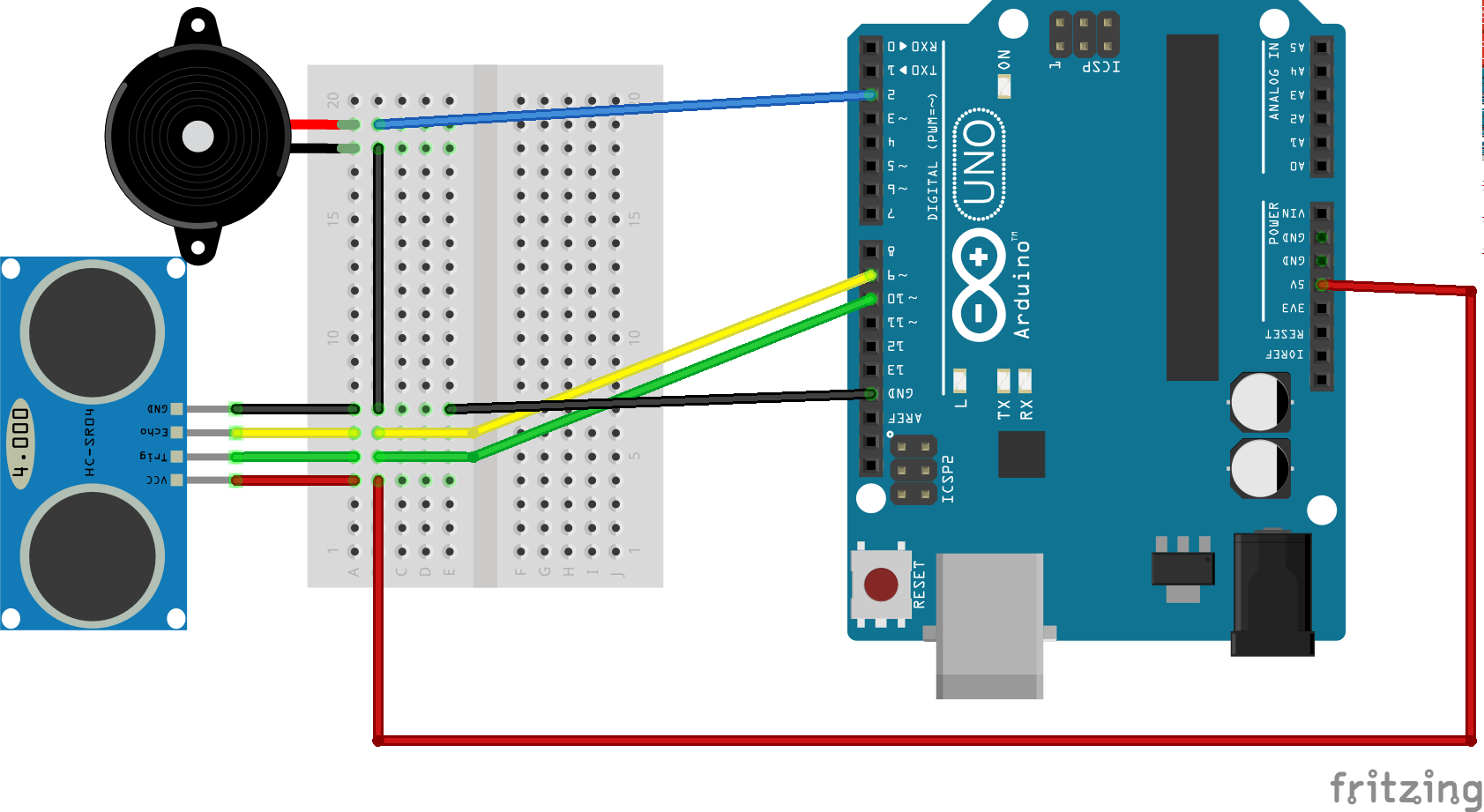
Voici la procédure pour le projet -
- Connectez la broche Trigger du capteur à la broche 2 de l'Arduino
- Connectez la broche Echo du capteur à la broche 3 de l'Arduino
- Connectez Vcc et GND du capteur à l'alimentation et à la masse respectivement
- Placez le buzzer sur la plaque d'essai
- Connectez sa borne positive à la broche 10 de l'Arduino et la borne négative à la masse
- Connectez les fils noir et rouge du servomoteur à la masse et à l'alimentation respectivement
- Connectez le fil jaune du servomoteur à la broche 9 de l'Arduino
- Connectez le terminal 5 V de l'Arduino à l'alimentation et le terminal GND à la masse
Après avoir terminé ces connexions, placez l'ensemble du circuit à l'intérieur de la boîte comme indiqué sur la figure.
Puis vient le moment de coder.
Code
Code Arduino (C/C++)
#include <Servo.h>

int tPin = 2;
int ePin = 3;
int buz = 10;
int d1, d2;
int i = 0;
int sdistance;
Servo myServo;

void setup() {
  Serial.begin(9600);
  pinMode(tPin, OUTPUT);
  pinMode(ePin, INPUT);
  pinMode(buz, OUTPUT);
  myServo.attach(9);
}

void loop() {
  for (i = 0; i <= 180; i += 10) {
    myServo.write(i);
    delay(30);
    d2 = calculateDistance();
    Serial.print(i);
    Serial.print(",");
    Serial.print(d2);
    Serial.print(".");
  }
  for (i = 180; i > 0; i -= 10) {
    myServo.write(i);
    delay(30);
    d2 = calculateDistance();
    Serial.print(i);
    Serial.print(",");
    Serial.print(d2);
    Serial.print(".");
  }
}

int calculateDistance() {
  digitalWrite(tPin, HIGH);
  delay(1000);
  digitalWrite(tPin, LOW);
  d1 = pulseIn(ePin, HIGH);
  d2 = d1 * 0.0171821306;
  if (d2 < 10) {
    digitalWrite(buz, HIGH);
  } else {
    digitalWrite(buz, LOW);
  }
  return d2;
}
Code Processing (Java) – Visualisation Radar
import processing.serial.*;
import java.awt.event.KeyEvent;
import java.io.IOException;

Serial myPort;
String angle = "";
String distance = "";
String data = "";
String noObject;
float pixsDistance;
int iAngle, iDistance;
int index1 = 0;
int index2 = 0;
PFont orcFont;

void setup() {
  size(1366, 768); // ***MODIFIEZ CECI POUR VOTRE RÉSOLUTION D'ÉCRAN***
  smooth();
  myPort = new Serial(this, "COM3", 9600);
  myPort.bufferUntil('.');
}

void draw() {
  fill(98, 245, 31);
  noStroke();
  fill(0, 4);
  rect(0, 0, width, height - height * 0.065);
  fill(98, 245, 31);
  drawRadar();
  drawLine();
  drawObject();
  drawText();
}

void serialEvent(Serial myPort) {
  data = myPort.readStringUntil('.');
  data = data.substring(0, data.length() - 1);
  index1 = data.indexOf(",");
  angle = data.substring(0, index1);
  distance = data.substring(index1 + 1, data.length());
  iAngle = int(angle);
  iDistance = int(distance);
}

void drawRadar() {
  pushMatrix();
  translate(width / 2, height - height * 0.074);
  noFill();
  strokeWeight(2);
  stroke(98, 245, 31);
  arc(0, 0, (width - width * 0.0625), (width - width * 0.0625), PI, TWO_PI);
  arc(0, 0, (width - width * 0.27), (width - width * 0.27), PI, TWO_PI);
  arc(0, 0, (width - width * 0.479), (width - width * 0.479), PI, TWO_PI);
  arc(0, 0, (width - width * 0.687), (width - width * 0.687), PI, TWO_PI);
  line(-width / 2, 0, width / 2, 0);
  line(0, 0, (-width / 2) * cos(radians(30)), (-width / 2) * sin(radians(30)));
  line(0, 0, (-width / 2) * cos(radians(60)), (-width / 2) * sin(radians(60)));
  line(0, 0, (-width / 2) * cos(radians(90)), (-width / 2) * sin(radians(90)));
  line(0, 0, (-width / 2) * cos(radians(120)), (-width / 2) * sin(radians(120)));
  line(0, 0, (-width / 2) * cos(radians(150)), (-width / 2) * sin(radians(150)));
  line((-width / 2) * cos(radians(30)), 0, width / 2, 0);
  popMatrix();
}

void drawObject() {
  pushMatrix();
  translate(width / 2, height - height * 0.074);
  strokeWeight(9);
  stroke(255, 10, 10);
  pixsDistance = iDistance * ((height - height * 0.1666) * 0.025);
  if (iDistance < 10) {
    line(pixsDistance * cos(radians(iAngle)), -pixsDistance * sin(radians(iAngle)),
         (width - width * 0.505) * cos(radians(iAngle)), -(width - width * 0.505) * sin(radians(iAngle)));
  }
  popMatrix();
}

void drawLine() {
  pushMatrix();
  strokeWeight(9);
  stroke(30, 250, 60);
  translate(width / 2, height - height * 0.074);
  line(0, 0, (height - height * 0.12) * cos(radians(iAngle)), -(height - height * 0.12) * sin(radians(iAngle)));
  popMatrix();
}

void drawText() {
  pushMatrix();
  if (iDistance > 10) {
    noObject = "Out of Range";
  } else {
    noObject = "In Range";
  }
  fill(0, 0, 0);
  noStroke();
  rect(0, height - height * 0.0648, width, height);
  fill(98, 245, 31);
  textSize(25);
  text("2cm", width - width * 0.3854, height - height * 0.0833);
  text("4cm", width - width * 0.281, height - height * 0.0833);
  text("6cm", width - width * 0.177, height - height * 0.0833);
  text("10cm", width - width * 0.0729, height - height * 0.0833);
  textSize(40);
  text("Akshay6766 ", width - width * 0.875, height - height * 0.0277);
  text("Angle: " + iAngle + " ", width - width * 0.48, height - height * 0.0277);
  text("Distance: ", width - width * 0.26, height - height * 0.0277);
  if (iDistance < 40) {
    text(" " + iDistance + " cm", width - width * 0.225, height - height * 0.0277);
  }
  textSize(25);
  fill(98, 245, 60);
  translate((width - width * 0.4994) + width / 2 * cos(radians(30)), (height - height * 0.0907) - width / 2 * sin(radians(30)));
  rotate(-radians(-60));
  text("30", 0, 0);
  resetMatrix();
  translate((width - width * 0.503) + width / 2 * cos(radians(60)), (height - height * 0.0888) - width / 2 * sin(radians(60)));
  rotate(-radians(-30));
  text("60", 0, 0);
  resetMatrix();
  translate((width - width * 0.507) + width / 2 * cos(radians(90)), (height - height * 0.0833) - width / 2 * sin(radians(90)));
  rotate(radians(0));
  text("90", 0, 0);
  resetMatrix();
  translate(width - width * 0.513 + width / 2 * cos(radians(120)), (height - height * 0.07129) - width / 2 * sin(radians(120)));
  rotate(radians(-30));
  text("120", 0, 0);
  resetMatrix();
  translate((width - width * 0.5104) + width / 2 * cos(radians(150)), (height - height * 0.0574) - width / 2 * sin(radians(150)));
  rotate(radians(-60));
  text("150", 0, 0);
  popMatrix();
}
Schématiques
Processus de fabrication
- Détecteur de langue TinyML avec Edge Impulse sur Arduino Nano 33 BLE Sense
- Construire un jeu gyroscopique temps réel avec Arduino Nano et capteur MPU-6050
- Dé numérique Arduino sur écran LCD 16x2 – Générateur aléatoire à bouton poussoir
- Construire un Iron Man animé avec Arduino : capteurs, sons et relais
- Find Me : Localisateur d'objets intelligent avec Arduino et Bluetooth
- Contrôleur d'humidificateur DIY avec Arduino et relais – Installation haute tension sécurisée
- Mesure de distance en temps réel par sonar Arduino et visualisation Processing
- MobBob : Construisez votre propre robot Arduino, contrôlé via smartphone Android
- Construire une lampe de bureau réactive à l'audio avec Arduino Nano